

An ingrown toenail is a common problem where the nail grows into the toe. It can be painful, but there are things you can do to ease the pain.
Refer yourself to Podiatry if the above advice does not resolve the issue after 2 weeks.
Check if you have an ingrown toenail
You usually get an ingrown toenail on your big toe. But you can get them on any toe.
Your toe may be red, painful and swollen.
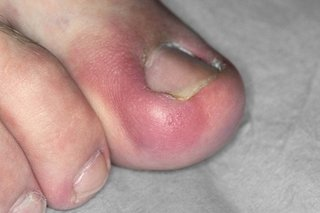
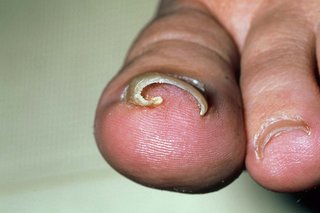
Your toenail may curve into your toe.
How to treat an ingrown toenail
How to treat an ingrown toenail at homeIf you go to a GP or Podiatrist with an ingrown toenail, they’ll usually suggest you try these things first.
Do
- soak your foot in warm, salty water to help dry up the skin around your toe, which means it is more resitant to the nail rubbing on it. Salt water foot baths also reduce the chances of infection. 2 handfuls of salt in a washing up bowl with only enough water to cover the toe.
- keep your foot dry for the rest of the day
- wear wide, comfortable shoes or sandals with lace or velcro fastening
- take paracetamol or ibuprofen to ease the pain
Don’t
- do not cut your toenail – leave it to grow out
- do not pick at your toe or toenail
- do not wear tight, pointy or slip on shoes
Surgery may be recommended if your toenail doesn’t improve. Depending on the severity of your symptoms, this may involve removing part or all of your toenail.
Partial nail avulsion
Partial nail avulsion removes part of your toenail and is the most commonly used operation for treating ingrown toenails. It’s about 98% effective.A local anaesthetic is used to numb your toe and the edges of your toenail are cut away. A chemical called phenol is applied to the affected area to prevent the nail growing back and becoming ingrown in the future.
Total nail avulsion
Total nail avulsion completely removes your toenail. This may be necessary if your nail is thick and pressing into the skin surrounding your toe. After your toenail has been removed, you’ll have an indentation where your nail used to be. However, it’s perfectly safe for you not to have a toenail.
After surgery
After toenail surgery, your toe will be wrapped in a sterile bandage. This will help stem any bleeding and prevent infection. Rest your foot and keep it raised for 1 to 2 days after the operation.
To help reduce the pain, you may need to take a painkiller, such as paracetamol, and wear soft or open-toed shoes for the first few days after surgery.
Contact us: Podiatryadmin@borders.scot.nhs.uk or 01896 827427