Labour Ward/Triage telephone number – 01896 826896
The BGH welcomes approximately 850 babies into the world each year.
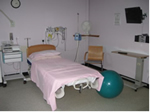
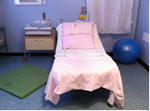
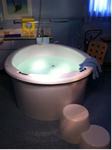
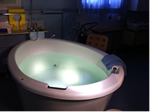
Our labour ward has 5 delivery rooms. 1 of which has a birthing pool and 1 has a birthing couch available to use. Dimmed lighting, music, birthing balls, mats, TENS machine, Entonox and aromatherapy can be available in all rooms.
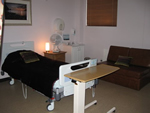
The Eildon room is also situated in labour ward; this is a quiet room with ensuite facilities for families to use under special circumstances.
You are welcome to bring 2 birthing partners with you while you are in labour ward. Please note there is no waiting area available.
Labour Delivery Rooms
Eildon Room
Latent stage of labour/Early labour
The latent stage of labour is where your cervix starts to soften, shorten and begins to open. It is often the longest stage of labour.
You may begin to feel irregular contractions, but it can take many hours, or even days, before you're in established labour.
At this stage, your contractions may range from being slightly uncomfortable to more painful. There is no set pattern to how many contractions you get or how long they last.
During the latent stage, it's a good idea to have something to eat and drink because you'll need energy for when labour is established.
If your labour starts at night, try to stay comfortable and relaxed. Sleep if you can.
If your labour starts during the day, stay upright and gently active. This helps your baby move down into your pelvis and helps your cervix to dilate.
Breathing exercises, massage and having a warm bath or shower may help ease pain during this early stage of labour.
When to call the hospital
You can call the labour ward triage number at any time for advice.
• If you think you may be in labour
· Painful regular contractions coming roughly every 2-4 min lasting approx 45-60 seconds
• If you think your waters have broken
• If you are concerned that your baby’s movements have altered from the normal pattern
• If you have any vaginal bleeding
• If you have any signs of labour prior to 37 weeks pregnant (premature)
• Concerns that you are unwell (e.g. you have a temperature)
• You need reassurance
• Any other worries
What to pack for hospital?
You may be wondering what you need to bring to hospital, please see Ready Steady Baby information for a helpful list.
What to take with you for labour and birth | Ready Steady Baby!
NOTE - you will need a car seat if you are driving your baby home but this can stay in the car until needed.
Pain relief in labour
Your midwife can discuss your birth plan and pain relief options at any stage of your labour. Pros and cons of each option can be discussed if you are unsure.
Non-drug pain relief
• Relaxation and breathing techniques can help to calm you and cope with the pain without being overwhelmed.
• TENS machine. Often most helpful at the beginning of your labour.
• Complementary therapies – many of our midwives are trained to use aromatherapies in labour, we have a supply of oils to choose from.
• Birthing pool - The buoyancy of the water makes you feel lighter and enables you to get into more comfortable positions keeping you more upright, this gives the advantage of working with gravity as your labour progresses.
Entonox (Gas and Air)
l Is safe to use throughout labour and there’s no danger of having too much. It leaves your body quickly and won’t stop you using other pain relief.
Morphine Sulphate (Opioid drugs)
• Diamorphine and other opioid drugs are usually given as an injection into a big muscle, such as your buttock or the top of your leg.
• It takes around 15 minutes to work and lasts between 2-4 hours.
• It can make you feel sick so we often give you an anti-sickness medication at the same time.
• Can make your baby sleepy and less interested in feeding in the first 24, especially if given close to the time of birth
Epidural
• An epidural is the most effective form of pain relief available.
• A needle is used to place a small tube in your back, medicines are put through the tube into the area around your spinal nerves (the epidural space). This blocks the feeling of pain in your lower body, but you can still feel someone or something touching you and the pressure as your baby’s being born.
• Can be used for caesarean section or forceps delivery by topping it up with stronger medication
• Can make you more likely to need an assisted delivery with forceps or ventouse as it can make pushing more difficult.
More detailed information can be found on NHS Inform