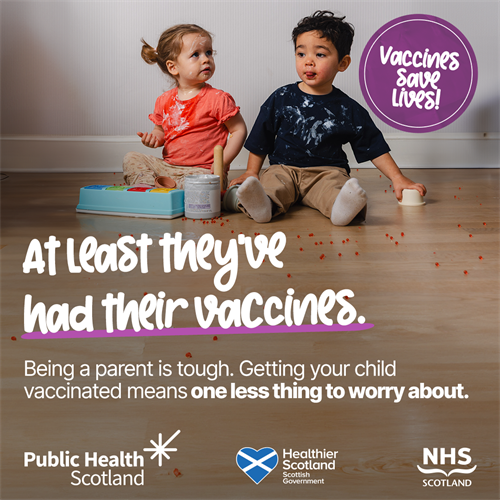
One less thing: Childhood vaccination
Throughout your child’s early years, they will be offered a number of routine vaccines between the ages of 0-4 years old. These vaccines are designed to protect them from a range of serious diseases such as polio, tetanus and many more. Many of the diseases these vaccines protect against are now rare in Scotland thanks to successful vaccination programmes. This is why you may not have heard of some of them.
However, uptake of childhood vaccinations in Scotland has declined over the past decade, especially among babies and pre‑school children. When fewer children are vaccinated, these diseases can return and spread more easily.
Some of the diseases prevented by vaccines can lead to long-term health problems, and others can even be life-threatening. Vaccination is the safest and most effective way to keep children protected as they are proven to save lives by reducing the spread of disease.
We also acknowledge that being a parent can be tough and at times it can feel overwhelming. When you’re tired and stretched, the important decisions can feel hard to make. But knowing your child is vaccinated and protected means it’s one less thing to worry about, leaving you free to deal with everything else that comes your way.
👋 Welcome to the Vaccination Service
Vaccines are one of humanity’s greatest achievements. Since 1974, they’ve saved 154 million lives – that’s more than 3 million lives a year or six people every minute for five decades. In the same period, vaccination has reduced infant deaths by 40%, and more children now live to see their first birthday and beyond than at any other time in human history. Measles vaccine alone accounts for 60% of those lives saved.
The NHS in Scotland offers immunisation through pregnancy, childhood, young adulthood and later life, to give everyone the best possible chance to pursue a long life, well lived.
When enough of the population are protected from a specific disease by a vaccination, this helps prevent the spread of that infection in the community.
To find out about vaccines you’re eligible for or to catch up on any vaccines you may have missed, click on nhsinform.scot/gettingvaccinations or call the NHS Inform helpline 0800 22 44 88 (open 9am to 6pm Monday to Friday, 9am to 1pm on Saturday and closed on Sunday).
What’s the difference between vaccination and immunisation?
Vaccination means receiving a vaccine, either by injection, nasal spray or oral vaccine.
Immunisation means receiving a vaccine then becoming immune to a disease. Vaccinations encourage your body’s immune system to produce antibodies that will fight off a virus or bacteria.
Changes to the way vaccinations are given in the Borders
Since October 2021, responsibility for vaccinations has moved from GPs practices to NHS Borders Vaccination Service as part of the Primary Care Improvement Plan.
The Vaccination Service leads the delivery of immunisation programmes in partnership with public health, school immunisation, community nursing, occupational health, maternity services, general practice, acute services and the wider Scottish Borders Health and Social Care Partnership.
In Scotland there are a number of national immunisation programmes:
- Babies & pre-school
- COVID-19
- Flu
- Routine childhood
- Schools
- Pertussis for pregnant women
- Pneumococcal
- Shingles
- Non routine vaccinations by referral
- Travel
- Respiratory Syncytial Virus (RSV)
Key contact:
NHS Borders Vaccination Hub: 01896 809 250
Useful links:
NHS Inform Immunisation | NHS inform
World Health Organization Vaccines and immunization