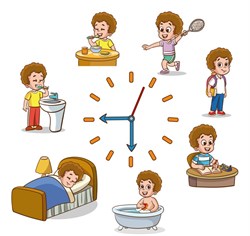
Both children and adults need to engage in Activities of Daily Living (ADL’s)to function within their environment. These tasks can be very complex for children to learn. It is important to understand how their skill level and sensory needs may be affecting their independence and participation in such tasks.
These videos will provide you with specific sensory advice and strategies relating to your child's activities of daily living. Transcripts for each video are available to download:
| Dressing |  |
Transcript |
| Hair Care |  |
Transcript |
| Toileting |  |
Transcript |
| Nail Care |  |
Transcript |
|
|
 |
Transcript |
| Toothbrushing |  |
Transcript |
| Eating |  |
Transcript |
| In the Community |  |
Transcript |
Pyramid Solving Tool
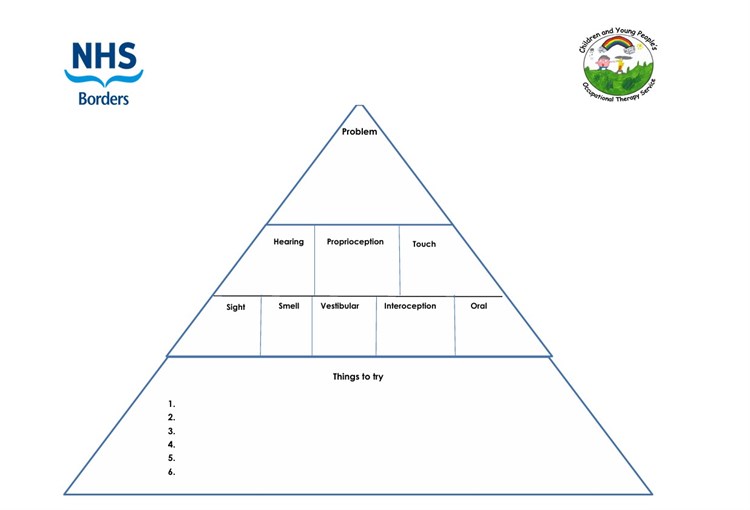
Once you have watched the videos you can use our pyramid problem solving tool that you can download below. This problem-solving tool helps us to think about the behaviour and the possible underlying sensory causes. By putting the problem at the very top of the triangle then starting to think about each of the sensory systems below, you may be able to identify if there is a sensory reason for the problem. At the bottom of the pyramid, you list the strategies you wish to try. Click the image to download.
You can use one for each identified difficulty to support you to implement strategies and support your child or young person in everyday life.
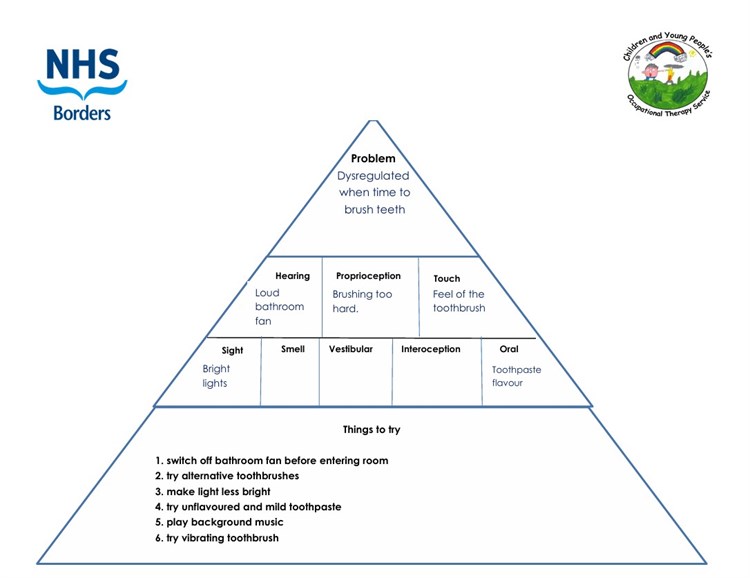
In the example below for toothbrushing, using the problem of upsetwhen it’s time to brush teeth, we have given examples of the sensory systems that might be receiving too much feedback and strategies you can use to change that, such as trying alternative toothpaste and a vibrating toothbrush. Click the image to download.
It can take several months for sensory strategies to be used effectively. You will likely need to use the strategies you think work best, for you and your child, consistently for around 3 months before knowing for certain that they work. Be prepared for them not to work each time so have a few sensory strategies that can be used in these situations.
It may be helpful to explore our activities of daily living section and also the Sensory Resources Section for further reources and information