MenB vaccination update: 23 July 2026
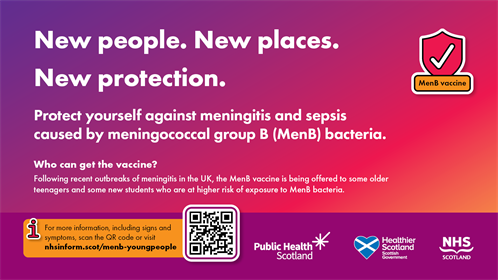
New people. New places. New protection.
Following recent outbreaks of meningitis in the UK, the MenB vaccine is being offered to some older teenagers and students under 25 who are at higher risk of exposure to meningococcal group B bacteria. This time-limited programme will be offered to some older teenagers and some new college and university students who are at higher risk of exposure to meningococcal group B bacteria.
Meningococcal disease is a rare but dangerous bacterial infection that can cause meningitis and sepsis. Both of these illnesses can be life-threatening if not treated quickly. Meningococcal bacteria can spread through close contact with someone who has the bacteria in the back of their throat. This includes living in the same household, kissing, or sharing drinks or vapes with someone. Two doses of the MenB vaccine will help to protect you against the most common strains of meningococcal group B bacteria in the UK.
If you’re eligible for the MenB vaccine, don’t miss your chance to protect yourself against serious diseases like meningitis and sepsis.
For more information and to find out if you or someone you know is eligible for the vaccine visit nhsinform.scot/menb-youngpeople.
Next steps
If you were born between 1 March 2008 and 28 February 2009, you should have received a letter explaining how to book your MenB vaccination appointment.
Letters have only been sent to this age group. If you are eligible through any of the following groups, please contact the Vaccination Service on 01896 809250 to arrange your appointment.
- You were born between 1 March 2008 – 28 February 2009
- You were in S6 in 2025/2026
- You are under 25 and starting first year at university in 2026/2027
- You are under 25, starting first year at college and living in shared accommodation
Two doses, given four weeks apart, are essential for full protection.
We're also running a MenB drop-in vaccination clinics on:
-
Tuesday 11 August, 1400-1700, Galashiels Volunteer Hall
-
Wednesday 12 August, 1600-1700, Galashiels Volunteer Hall
-
Thursday 13 August, 1430-1600, Coldstream Health Centre
-
Thursday 13 August, 1530-1700, Earlston Health Centre
-
Thursday 13 August, 1600-1730, Jedburgh Health Centre
-
Friday 14 August, 1600-1730, Selkirk Health Centre
-
Monday 17 August, 1330-1630, Haylodge Health Centre, Peebles
Just drop in when it suits you. No booking is required, but there may be a short wait at busier times.
Frequently Asked Questions
Have I/has my child been vaccinated against meningitis?
MenB vaccine, which protects against meningococcal group B bacteria, has been part of the routine childhood vaccination schedule in the UK since 2015.
Anyone born before 2015 will not have received MenB vaccine as part of their childhood schedule. More specifically, babies born on or after the 1 July 2015 were offered MenB vaccine.
Teenagers are routinely offered the MenACWY vaccine as part of the school immunisation programme, usually in S3 when they are about 14 years old. This vaccine protects against meningococcal groups A, C, W and Y. MenACWY does not protect against meningococcal group B.
I have/my child has missed their meningitis vaccine appointment. Who do I contact to arrange vaccination?
Children who have not yet received all their scheduled doses of MenB vaccine can be offered catch-up doses up to 2 years of age. To arrange an appointment call NHS Borders Vaccination Hub on 01896 809250.
Anyone who has not yet received their MenACWY vaccine can still get it up until their 25th birthday. This is especially important before starting university or college. To arrange an appointment, contact the Vaccination Hub on the number above.
Why can’t I/my child get MenB vaccine?
Recommendations about who should be offered vaccines are made by the Joint Committee on Vaccination and Immunisation, which is an independent expert group that advises the government on vaccine policy. Their recommendations are based on protecting those at highest risk.
While it is very effective at protecting infants against meningococcal disease, the MenB vaccine offers limited impact on reducing nasopharyngeal (nose and throat) carriage and transmission, and it does not cover all circulating MenB strains. The vaccination takes between 3-4 weeks for immunity to fully develop.
There are currently no plans to offer MenB vaccine routinely to anyone other than infants as part of the routine schedule.
If anyone in Scotland needs the vaccine as part of an outbreak response, they will be contacted directly.
Am I at risk of meningitis?
Public health teams in England are responding to an outbreak of group B meningococcal disease in Kent. This situation is local to that area and there is currently no evidence of any increased risk in Scotland. Public Health Scotland are monitoring the situation closely and will provide any updates to current advice as appropriate.
Routine vaccinations provide good protection against infections including meningitis and meningococcal disease, but the bacteria can sometimes escape this protection. Young infants and adolescents are at highest risk of meningococcal disease, especially if not fully vaccinated, but anyone can become seriously unwell from meningitis or septicaemia (sepsis).
Acting quickly saves lives. It is vital for everyone to be aware of the signs and symptoms of meningitis and related disease, and what to do if you have concerns.
What are the symptoms of meningitis?
Symptoms can include:
- fever
- severe headache
- vomiting or diarrhoea
- cold hands and feet
- drowsiness or confusion
- rapid breathing
- stiff neck
- dislike of bright lights
- joint or muscle pain
- a rash that does not fade under a glass
Symptoms can appear in any order and may be mistaken for a cold, flu, or hangover - especially in teenagers and students. For further information, see Meningitis | NHS inform.
If you or anyone you know develops symptoms seek immediate medical help:
Call 111 or your GP if you’re unsure or worried about symptoms or you think you may have been exposed to someone with meningitis.
Call 999 or go to A&E if someone seems seriously unwell.
Useful contacts
http://www.nhsinform/menb-youngpeople
Getting your vaccinations | NHS inform
www.nhsinform.scot/vaccinesforstudents
Kent meningitis outbreak: March 2026 – UK Health Security Agency
Who is eligible for the new one-off MenB vaccine programme? – UK Health Security Agency
Meningitis - Symptoms, Causes and Treatments | Meningitis Now
National vaccination helpline: 0800 030 8013. Open from 9am to 6pm Monday to Friday, 9am to 1pm on Saturday and closed on Sunday and bank holidays.
NH24 helpline: 0800 22 44 88 open Monday to Friday from 9am to 5pm.
Tuesday 4 August, 1600-1730, Eyemouth Day Hospital
Thursday 6 August, 1500-1730, Hawick Community Hospital
Thursday 13 August, 1430-1600, Coldstream Health Centre
Thursday 13 August, 1530-1700, Earlston Health Centre
Thursday 13 August, 1600-1730, Jedburgh Health Centre
Friday 14 August, 1600-1730, Selkirk Health Centre